Polkadot’s community voted to put consumer applications and digital payments at the center of its dotUSD strategy. In its weekly RWA roundup published November 20, 2026, PANews reported that the proposal passed on November 11 with 97% support. The vote sets a direction; it does not mean the proposed features are already available.
The Polkadot Community Foundation’s strategy emphasizes privacy, user control and mobile-first services. Later stages would let users lock DOT as collateral to mint dotUSD. The plan also envisages private messaging and digital-cash payments through the Polkadot App. For a community-led network, the vote is a concrete expression of what participants want to build next—not evidence yet of everyday adoption.
More holders, less value transferred
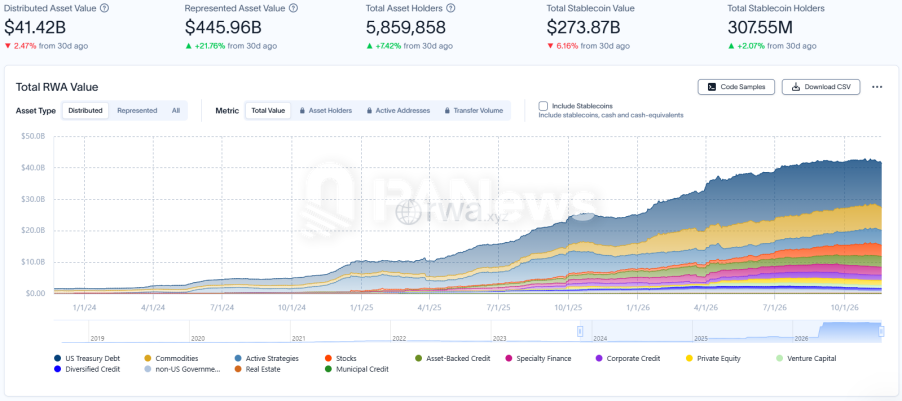
PANews cited RWA.xyz figures showing $41.42 billion in on-chain RWA value as of November 20, down 2.47% from the same point a month earlier. The article text put asset holders at 5.8599 million, up 2.42% month over month. The source graphic shows a different 30-day holder-growth figure, 7.42%; the source does not explain the discrepancy.
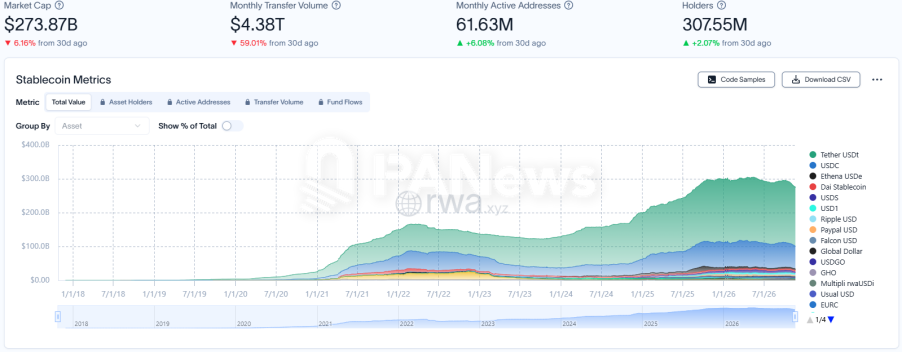
Stablecoin market value stood at $273.87 billion, down 6.16% month over month, while monthly transfer volume fell 59.01% to $4.38 trillion. Over the same comparison period, monthly active addresses rose 6.08% to 61.63 million and holders rose 2.07% to 308 million. Those figures show different movements in transfer activity and participation measures; they do not, by themselves, establish why either changed.
Pilots, proposals and live products
Several developments in the November 13–20 reporting period concerned how tokenized money could move between institutions. The Hong Kong Monetary Authority said it was working with Swift and banks to explore interoperability for multicurrency tokenized deposits. In Singapore’s BLOOM initiative, StraitsX, OCBC and Standard Chartered completed a controlled interoperability proof of concept; the parties said legal, regulatory and commercial arrangements still needed assessment before implementation. Ant International also reported a pilot connecting tokenized deposits and a tokenized money-market fund through its Whale protocol.
The roundup distinguished those tests from other steps already taken. It reported that the Monetary Authority of Singapore issued S$100 million—about US$77 million—in tokenized MAS bills on November 6 and settled them with wholesale central bank digital currency. Invesco’s stablecoin reserve fund had begun issuing tokenized shares on Ethereum, according to the report. Separately, Coinbase and Broadridge proposed a standard for shareholder communications and voting involving tokenized stocks; the proposed standard is not itself a completed voting rollout.
The week’s activity spanned community governance, institutional tests and issued assets. Each is a different measure of progress, and none alone establishes that tokenized products have reached broad use.