Water Drip Capital took its name from the “droplet” in Liu Cixin’s The Three-Body Problem. Co-founder Dashan said the founders once imagined blockchain as a technology capable of disrupting traditional finance. In an interview published on November 10, 2026, he described a narrower ambition: crypto as infrastructure for other parts of the digital economy, particularly AI.
The interview, conducted by Wu Blockchain, paired Dashan with Xiaoyang, who works at a smaller crypto-focused VC. Their funds differ in size, but both described struggling to turn early investments into exits.
Two portfolios, similar difficulties
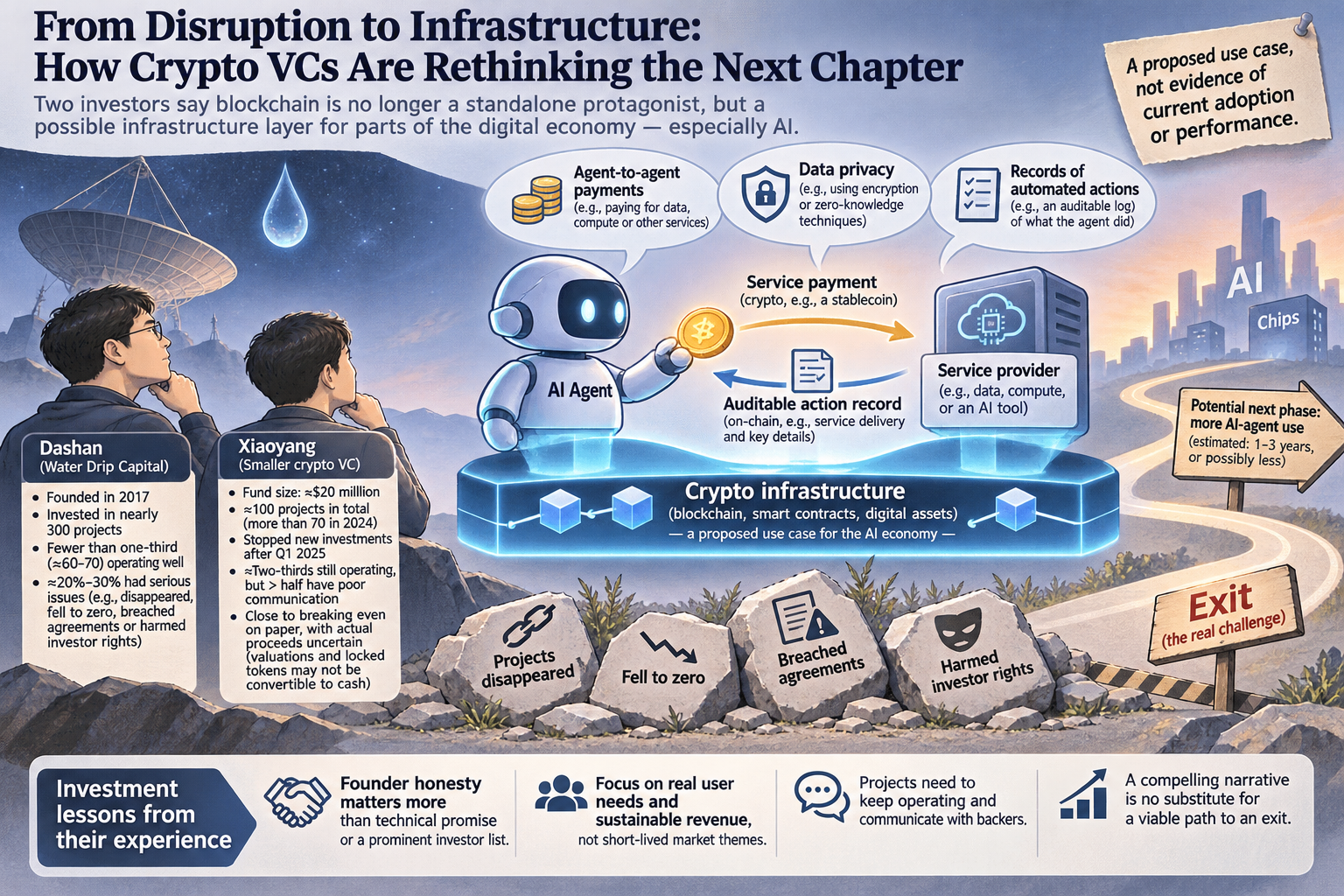
Founded in 2017, Water Drip has invested in nearly 300 projects. Dashan said that only about 60–70—fewer than one-third—were still operating well by the fund’s assessment. He estimated that roughly 20%–30% of its investments involved projects that disappeared, fell to zero, breached agreements or harmed investor rights. Those are different outcomes, not a claim that all of those projects were scams.
Dashan said Water Drip had invested in more than a dozen projects in 2026, but only three or four were primarily crypto-related. Most of the others were in AI and chips. He argued that founder honesty matters more than technical promise or a prominent investor list, citing experiences with allegedly exaggerated credentials, unmet commitments and disputes over token unlocks.
Xiaoyang described a fund of approximately $20 million that has invested in about 100 projects, including more than 70 in 2024. It stopped making new investments after the first quarter of 2025, across AI as well as crypto. Xiaoyang said roughly two-thirds of its portfolio remained operational, but effective communication with investors was difficult for more than half of the projects. The fund was close to breaking even on paper; Xiaoyang cautioned that its eventual proceeds could be lower because valuations and locked tokens cannot necessarily be converted into cash.
The AI-agent thesis remains a thesis
Dashan sees potential uses for crypto in payments between AI agents, data privacy and records of automated actions. He also pointed to real-world asset tokenization as a way to serve traditional finance. His view is not evidence that AI agents already create substantial demand for these services: he said widespread agent use would need to come first and suggested that might take one to three years, or possibly less.
Xiaoyang likewise favored products addressing real user needs and sustainable revenue over short-lived market themes, but said the fund had no immediate plan to resume investing. Xiaoyang also mentioned hearing that some funds faced dissolution after losses, while explicitly saying those accounts were unverified and could not characterize the industry as a whole.
The shift in these investors’ language—from blockchain as a disruptive protagonist to crypto as a possible supporting tool—does not establish where the next market will go. Their portfolio accounts instead show a present constraint: a compelling narrative is no substitute for projects that keep operating, communicate with backers and offer a viable path to an exit.