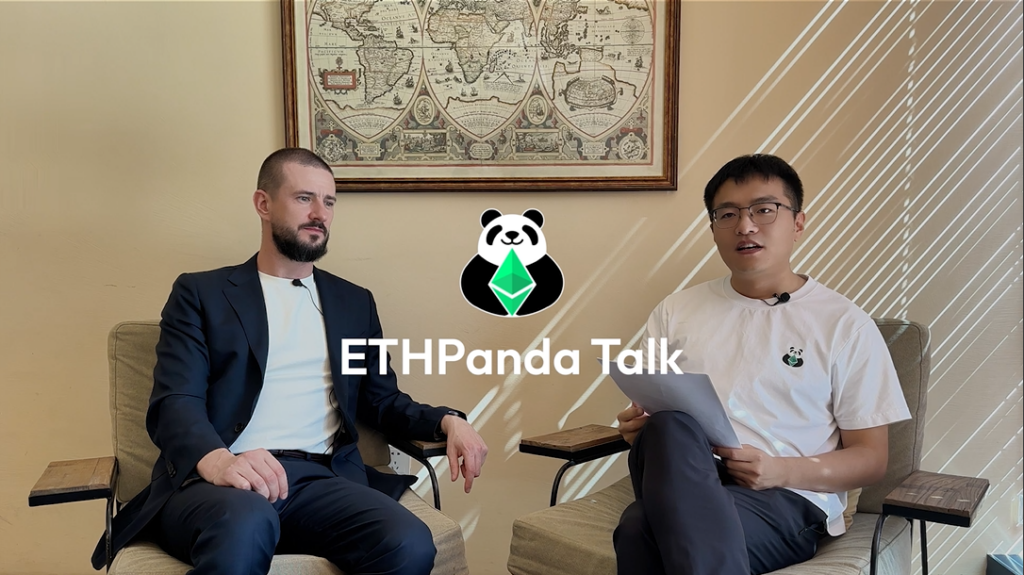
In an ETHPanda Talk interview published on December 29, 2025, Ethereum Foundation co-executive director Tomasz Stanczak described a problem that cannot be solved by code alone: getting teams across Ethereum’s layer-2 ecosystem to work together. Engineers may want interoperable systems, he said, while the people responsible for strategy and business decisions may see reasons to preserve distinctions between their networks.
Stanczak proposed bringing layer-2 engineers and researchers together for a dedicated in-person meeting the following year. He said the idea came from engineers who told him they rarely met their counterparts at other layer-2 teams. It was a proposal, not an event he said had already taken place.
From building a client to building connections
Stanczak founded Nethermind in 2017 and joined the Ethereum Foundation in March 2025, according to his account of his career in the interview. He said curiosity about Ethereum’s yellow paper led him to build a client, initially without knowing how easily he could contact other core developers. That experience shaped his view of Ethereum as a permissionless place to contribute, but also one where newcomers may have to find their own path.
He credited London community connections with encouraging him to run EVM workshops and apply for an Ethereum Foundation grant. He said Nethermind received $50,000 through its first grant application and later gained its first paying customer, the xDAI network. These are milestones in Stanczak’s account, not a template he claimed every builder could follow: he also described the financial strain of starting the company with his savings.
At the foundation, Stanczak said he and co-executive director Hsiao-Wei Wang generally take responsibility for matters as they arise rather than requiring every decision to be made jointly. He described his work as more outward-facing and Wang’s as including substantial internal communication and operations, while noting that their roles could change.
Why interoperability is a community question
Of the foundation’s goals discussed in the interview—scaling Ethereum’s base layer, expanding blob capacity, and improving interoperability and user experience—Stanczak considered the last the hardest to measure. People can agree that an experience should improve while disagreeing about whether that means better security, privacy, speed or wallet design.
He identified bridge security, permissionless access and preservation of Ethereum’s censorship-resistant properties as obstacles to layer-2 interoperability. He discussed the Open Intents Framework and the proposed Ethereum Interoperability Layer as approaches under development, not as completed solutions. Even apparently small details, such as how wallets show an asset across different chains, matter to the experience he wants to improve.
Stanczak also described community work beyond protocol development: developer education, local gatherings and plans for a Hong Kong community hub in cooperation with Hong Kong Polytechnic University. His stated aim was to help connect people and resources without directing every community’s development from the foundation.
AI agents: an emerging idea, not an established outcome
The conversation turned to AI agents as a possible new area of Ethereum activity. Stanczak discussed ERC-8004 as a framework for agent identity, reputation and work verification, and x402 in connection with payment requests. He said the foundation’s dAI team, led by David Crapis, was coordinating work in this area. His view that AI agents could become a major direction for Ethereum was a forecast, not evidence that adoption was assured.
He was similarly speculative about AI participation in governance. Stanczak described a possible progression from agents commenting on proposals to contributing in developer meetings, while acknowledging the risk that whoever filters AI-generated ideas could influence which proposals receive attention. The interview leaves a distinction worth keeping: AI tools may help people participate in Ethereum, but neither technical standards nor a compelling narrative settle questions of trust, representation and human judgment.