On November 12, 2026, MegaETH’s shift toward AI inference was still a plan, not a working marketplace. Earlier that week, the MegaETH Foundation had rebranded as MEGA and announced a $30 million treasury commitment to build its own products. Its first proposed product, an AI inference marketplace, was expected to launch in December.
The pivot follows a steep drop in the chain’s total value locked: it stood below $10 million, down from a peak above $245 million in May. Co-founder Shuyao Kong said on X that, after building what she called the fastest blockchain without finding product-market fit, the team needed to change course. That is her account of the decision—not evidence that the new market has found demand.
The trust problem MEGA wants to solve
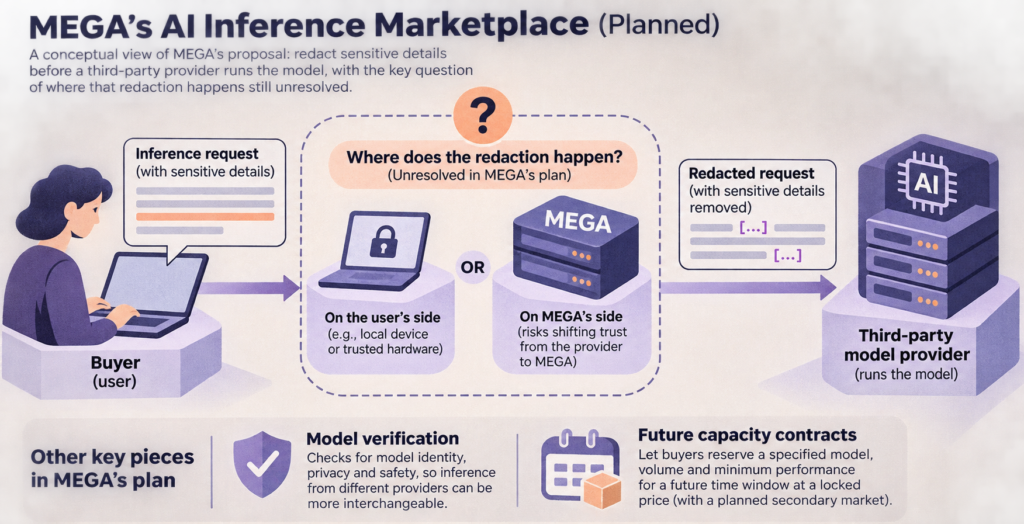
MEGA’s whitepaper argues that third-party providers can run the same open-source AI model for less than its developer, yet buyers may prefer the familiar official provider. One example given was OpenRouter pricing for GLM 4.6 output: $2.20 per million tokens from developer Z.ai, versus $1.75 from third-party provider Venice. MEGA proposes checks for model identity, privacy and safety so buyers can treat inference from different providers as more interchangeable.
But verification alone may be a weak differentiator. OpenRouter already favors lower-priced routes in its default routing and attributes many output-quality differences between providers to tool-calling configurations rather than deliberate model substitution. A study published in March 2026 did find that 46% of identity checks failed across three black-box resellers it tested; that result should not be generalized to all inference providers.
Other approaches are also advancing. Antseed has introduced model fingerprinting and offers buyers a trusted-execution-environment option. Anthropic has open-sourced FlashProve, a prototype for cryptographically checking model identity, though the reported compute cost is 70 to 95 times that of a normal inference request. MEGA’s whitepaper discusses such methods but does not specify which it will use.
Two proposals that could matter more
The whitepaper’s more distinctive ideas concern privacy and future capacity. It proposes removing sensitive details before a provider sees a request and splitting complex work between trusted and untrusted nodes. The crucial unresolved question is where that removal happens: if MEGA itself can see the original request, the user has shifted trust from the inference provider to MEGA rather than eliminated the exposure. A similar feature in Freysa’s Enchanted app, now called Silo, ran into uneven mobile performance; Freysa said in November 2025 that it had moved the processing off phones, and an iOS update listed the feature as removed.
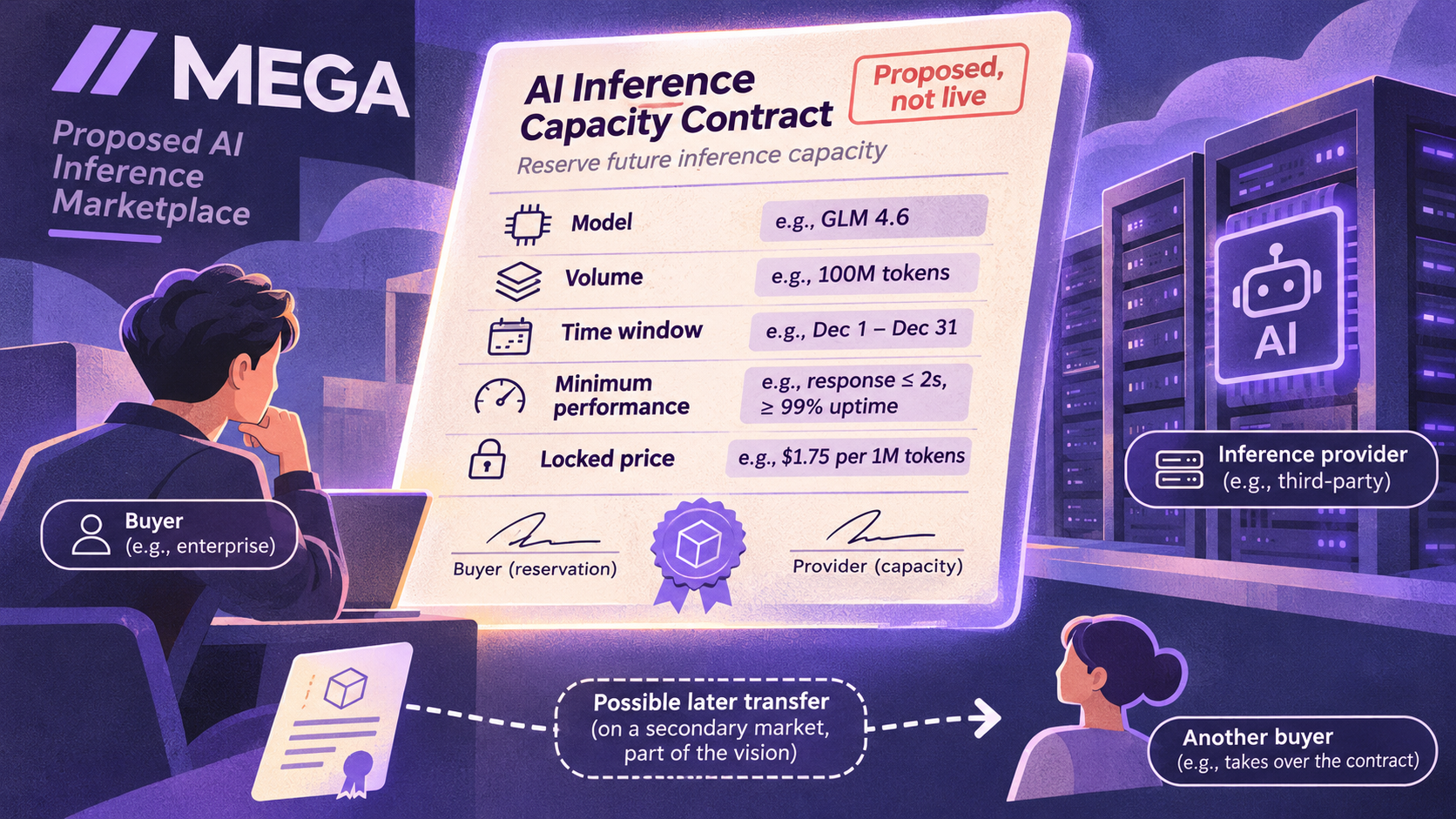
MEGA also proposes contracts through which buyers could reserve a specified model, volume and minimum performance standard for a future time window at a locked price. A later secondary market for those contracts is part of the vision, not an existing feature. The idea raises a practical question: with inference costs falling and leading models changing, which buyers would want to lock in a particular model months ahead? The original analysis suggested guaranteed capacity during peak demand as one possible answer, while leaving the question open.
As of the November 12 report, MEGA had not published code or identified the marketplace’s initial models and compute providers. The whitepaper did not explain provider admission, who would conduct checks, where privacy processing would run, or a role for the MEGA token. Kong told The Block that the team would use opportunities to benefit the token if it found them. Nor had MEGA detailed how it would spend the $30 million. The proposed launch would be the first chance to assess whether its privacy and capacity ideas extend beyond a whitepaper.