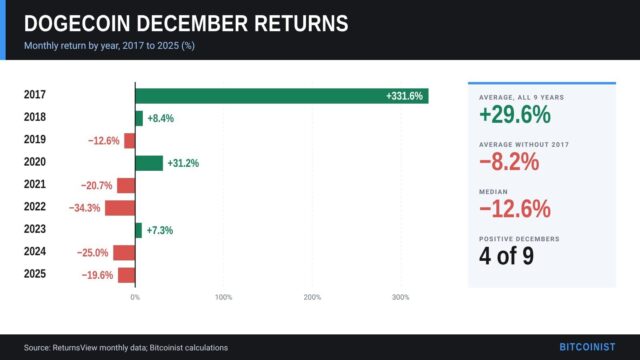
Dogecoin gained an average of 29.6% in December from 2017 through 2025, yet it ended the month higher in only four of those nine years. The reason is December 2017: DOGE rose 331.6% that month. Without it, the other eight Decembers averaged a loss of about 8.2%. The median return across all nine was −12.6%.
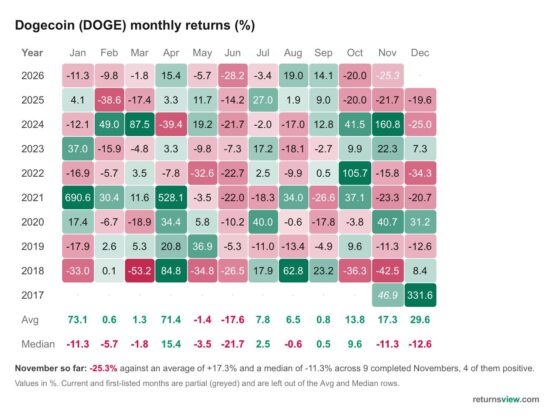
That distinction matters after two months of declines. According to monthly market data from ReturnsView, DOGE was down 25.3% for November 2026 through the close on November 26. After October’s 20% decline, that left the price roughly 40% below its end-of-September level.
What followed a November loss?
A December 2025 analysis by Bitcoinist examined whether Dogecoin’s November losses tended to continue into December. With 2025 complete, the 2017–2025 record includes five losing Novembers. Four were followed by another loss in December.
In 2021, DOGE fell 23.3% in November and a further 20.7% in December. In 2022, it lost 34.3% in December after a negative November. The pattern held in 2025, when a 21.7% November decline preceded a 19.6% December loss. The exception was 2018: DOGE gained 8.4% in December after falling 42.5% in November. Five cases are too few to establish a dependable pattern in either direction.
A rebound is not the same as a recovery
From the November 26 close, DOGE would need to gain nearly 34% to regain its November starting price. If November ended near that level, reversing the combined October and November losses would take a December gain of about 67%. Those figures measure the distance back to earlier prices, not the likelihood of reaching them.