As reported on November 23, 2026, a blocmates essay by 563defi surveyed crypto teams changing direction—from an NFT-linked consumer chain refocusing on its character brand to restaking protocols building financial products. The author argues that a pivot should be judged by whether it helps a team find users, rather than treated as a betrayal. The examples show a range of strategic changes, not proof that the new products have found product-market fit.
When the community story changes
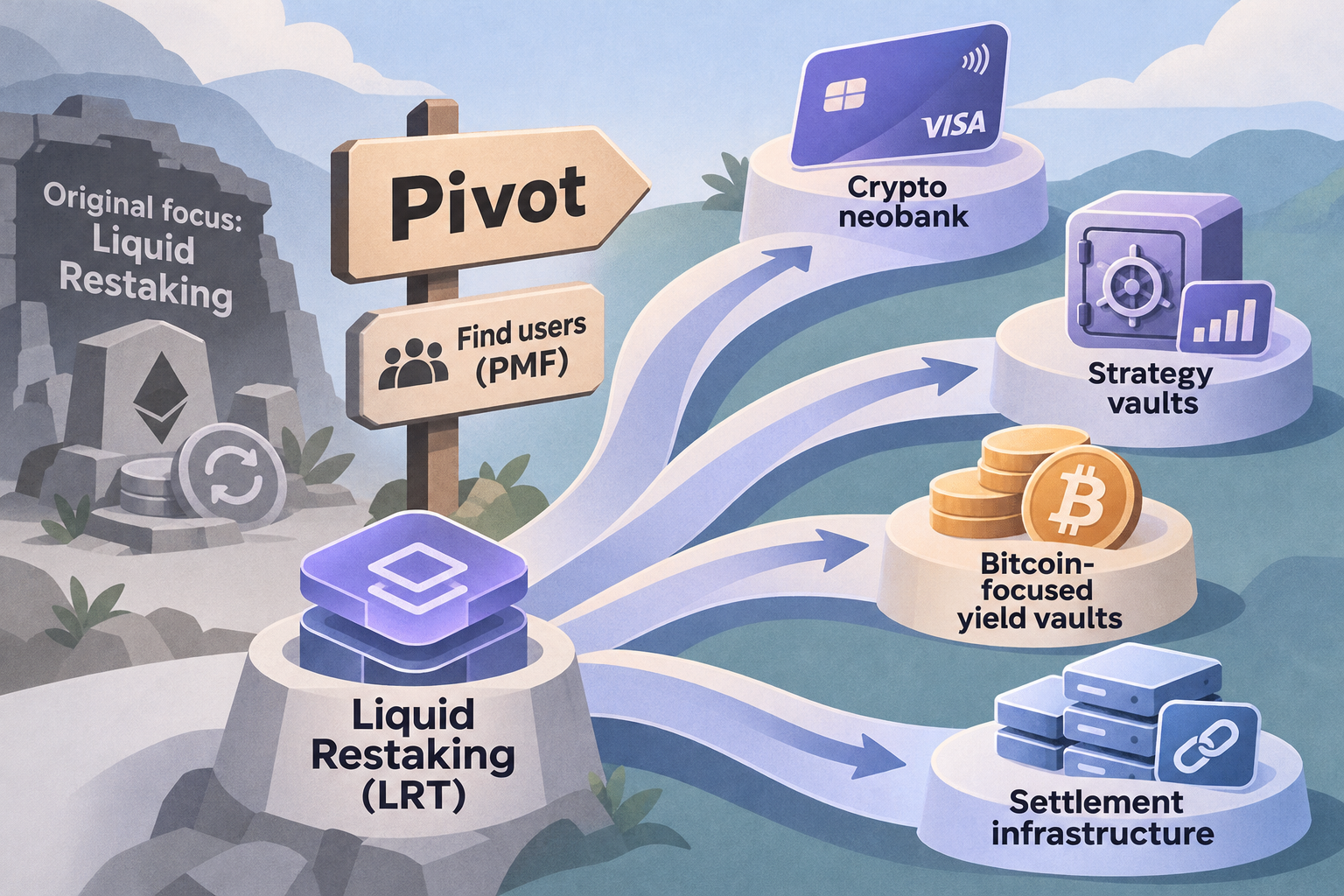
Igloo, the company behind Abstract and Pudgy Penguins, has pulled back from Abstract’s consumer-focused L2 ambitions to concentrate on Pudgy Penguins IP, NFTs and the PENGU token, according to the essay. The author notes that the team resisted community calls for an ABSTRACT chain token and brought in brands including Disney and Red Bull. The conclusion that Abstract failed to establish a viable consumer-chain business is the author’s assessment, not a demonstrated outcome for every part of the project.
Moonbeam offers a different kind of identity shift. Formerly a prominent EVM parachain in the Polkadot ecosystem, it announced in July 2026 that it would move its core business and GLMR token to Base. Its proposed focus is a network where AI agents can find one another, agree on work and settle it on-chain, with tasks held in smart contracts and assessed using cryptographic proofs.
Restaking teams look beyond restaking
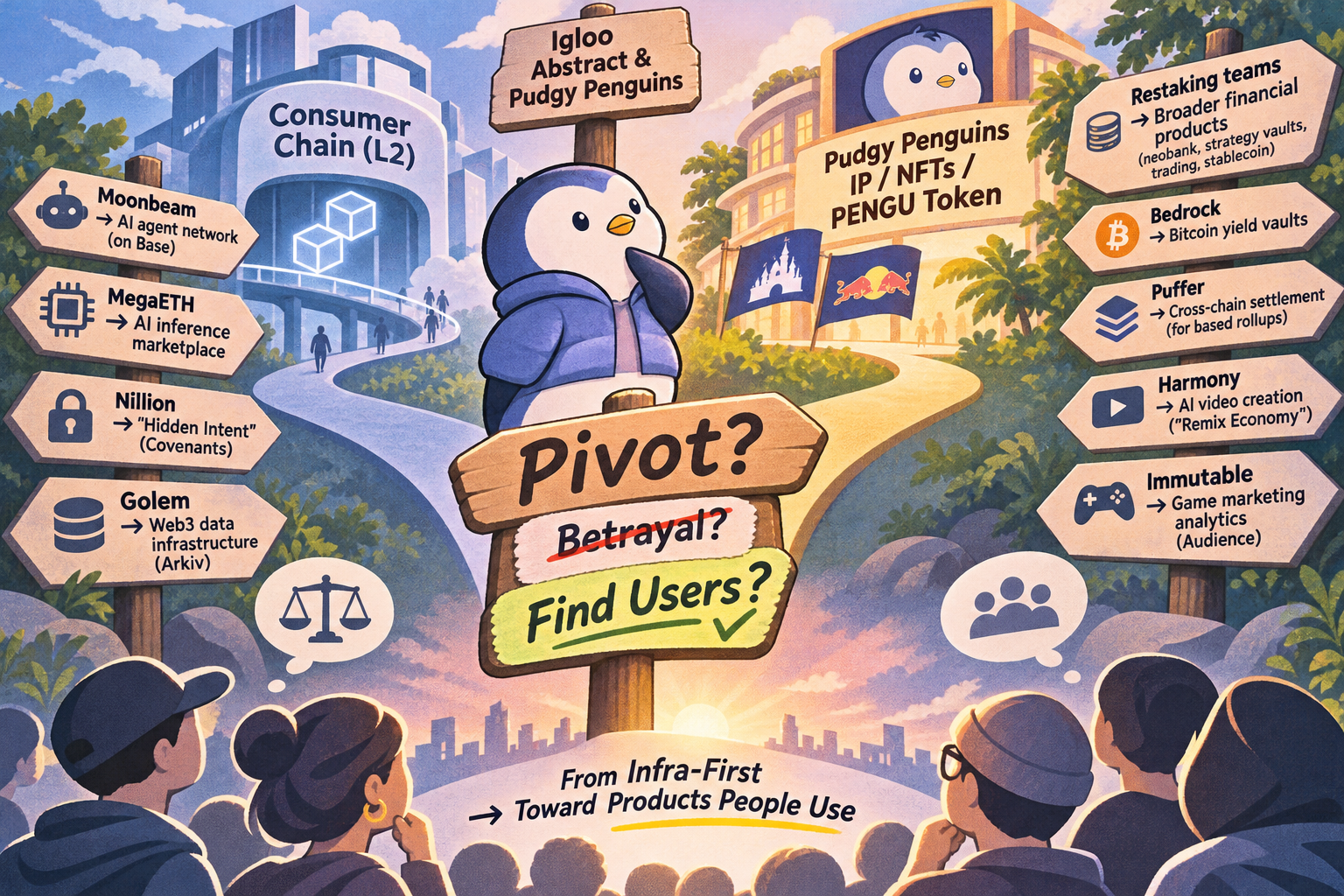
The essay groups several projects that began with liquid restaking but have since broadened or redirected their work. Ether.fi still retains its liquid-restaking business, while offering services the author describes as a crypto neobank: a Visa-supported crypto debit card, yield vaults, lending, spot trading and a native stablecoin.
Renzo Protocol has rebranded as Renzo Finance and repositioned itself around managed strategy vaults. It launched Renzo Basis, a delta-neutral basis-trading vault on Hyperliquid, on the day of its rebrand and was pursuing additional chains and perpetual-futures exchanges. After a hack, Kelp also shifted toward strategy vaults, working with Gains Network; its KUSD stablecoin for institutional payments and foreign-exchange settlement was a plan, not an existing service described in the essay.
Bedrock shifted its emphasis from Ethereum to Bitcoin, where the essay says most of its total value locked already sat, and focused on yield vaults allocating Bitcoin across DeFi lending, institutional products and delta-neutral trades. Puffer, by contrast, continued infrastructure work through UniFi, targeting cross-chain settlement for Ethereum L1-sequenced based rollups. Its proposed role as a fast settlement layer for AI agents remains a thesis. Swell announced Faro in October 2026, describing it as a non-custodial AI trading application built on Hyperliquid.
New uses for existing technology—and sharper departures
MegaETH said it would allocate $30 million to first-party products, beginning with an AI inference marketplace called Purified Intelligence that was expected to launch in December 2026. The team’s stated aim was to standardize inference services and provide on-chain verification of model use, privacy and pricing. Those are product goals, not benefits established for users by the essay.
Nillion narrowed its privacy-computing work toward a primitive it calls “Hidden Intent,” under the name Covenants. Golem presented Arkiv, a queryable, tamper-resistant Web3 data infrastructure project intended to use GLM for fees, at the Ethereum Devcon held earlier in November 2026. Both are closer to extensions or narrower applications of existing technology than wholesale exits.
Other changes are more pronounced. The essay says Harmony turned toward an AI video-creation platform after an August 2026 security incident in which attackers forged approximately 3 trillion ONE tokens, followed by contentious chain rollbacks. It describes a proposed “Remix Economy” in which users create and adapt video stories with prompts, while protocol inflation helps fund GPU costs. Immutable, meanwhile, cut almost all of its internal game-development team in June 2026 and focused on Audience, an AI marketing-analytics platform for game publishers. It opened Audience to unreleased indie games on Steam in August; the essay notes that the offering made no reference to blockchain. The author also reports IMX trading roughly 99% below its all-time high, a price observation that does not establish whether the new business will succeed.
The common thread is a search for products people will use. Whether these particular bets meet that test remains open. For communities attached to a chain, token or original mission, a pivot also changes what participation is meant to support—and gives users a reason to ask what has been delivered, rather than accepting either the old narrative or the new one on faith.