
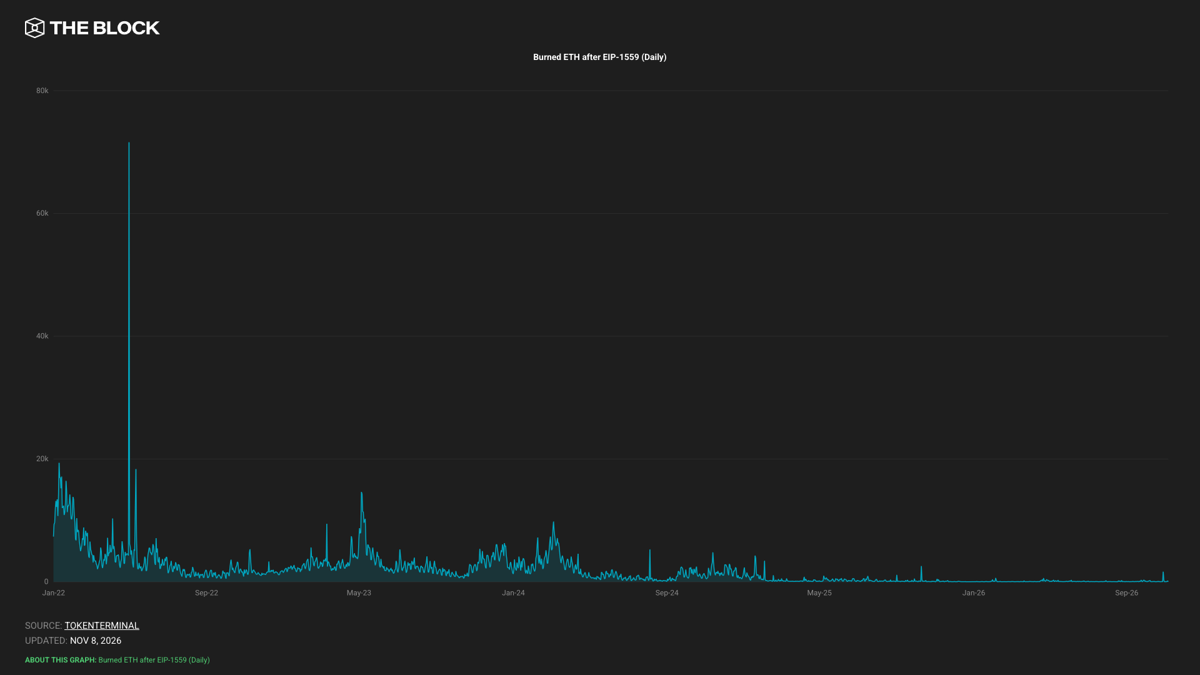
The Otherdeed NFT sale is a striking example of Ethereum’s fee-burning era: a rush to buy digital land in Yuga Labs’ Otherside metaverse drove an estimated $180 million in fees burned in one day. In a thread discussed by The Block on November 8, 2026, Ethereum co-founder Vitalik Buterin argued that spikes like this are a weak foundation for valuing ETH.
Buterin said Ethereum should keep EIP-1559, the mechanism introduced in 2021 that burns part of transaction fees. But holders “should not feel sad” if that burn remains below 10% of the level needed to offset new ETH issuance indefinitely, he wrote. In his view, ETH makes more sense as a store of value than as a token valued primarily for its fee burn.
Why the burn narrative falls short
The “ultrasound money” narrative gained traction among ETH holders during the 2021 bull market. Buterin said its implied valuation floor depends on a durable revenue stream: under one model he described, $1 billion in annual burn at a 4% discount rate would imply a $25 billion valuation. He argued that this was never a true floor because much of the burn from 2021 through 2023 came from activity within crypto that could decline alongside ETH’s price.
The Otherdeed sale illustrates both the intensity and the limits of that activity. Some buyers paid up to $10,000 in transaction fees for NFTs that, at the time of the report, sold for around $150. According to The Block’s data, Ethereum burned about 1.48 million ETH in 2022, compared with roughly 19,200 ETH so far in 2026 as of the November 8 report.
Buterin said tokenized real-world assets offer a stronger claim to demand from outside crypto, though he does not expect a mature market for them to produce comparable fee spikes. He instead emphasized Ethereum’s ability to survive and its decentralization, censorship and capture resistance, open source development, privacy and security. He also warned that optimizing for burn could encourage higher gas prices that price out users and require interventionist governance.
The debate has a live policy context, but no new burn rule was enacted. The authors of EIP-8363—a proposal to burn an increasing share of validator rewards as more ETH is staked—had withdrawn it from consideration for the forthcoming Hegota upgrade about five weeks before the report, following opposition. Reactions to Buterin’s thread included support from Solana co-founder Anatoly Yakovenko and a bullish interpretation from Moonrock Capital founder Simon Dedic; those responses do not establish a community consensus.
Source: theblock.co (originally published 2026-11-08 23:51 UTC+8)