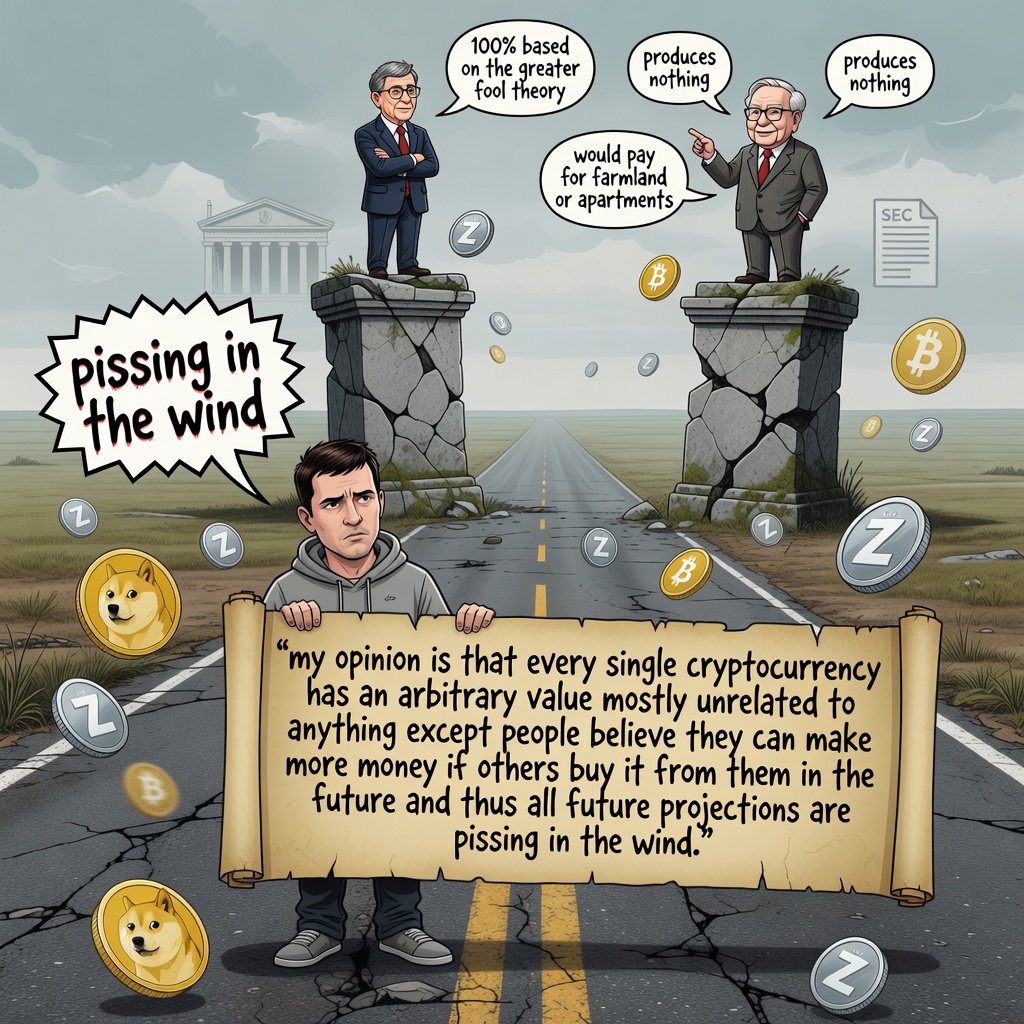
When an X user predicted that Zcash (ZEC) would fall to $100, Dogecoin co-founder Billy Markus didn’t offer a price target of his own. Posting as Shibetoshi Nakamoto on November 25, 2026, he argued that buyers’ expectations about what someone else will pay make crypto prices impossible to forecast reliably.
Markus wrote that “every single cryptocurrency has an arbitrary value” driven mostly by the belief that a buyer can later resell it for more. His verdict on price projections: “pissing in the wind.” He named no token in his reply, and his argument made no exception for Dogecoin.
Markus and Jackson Palmer launched Dogecoin in December 2013 as a joke about the crypto market, borrowing the Shiba Inu from the Doge meme. Markus has said he wrote the code in a couple of hours. In 2021, he recalled selling all his DOGE in 2015 after losing his job and getting roughly the price of a used Honda Civic. He has remained active on X, often replying to posts about new tokens and price forecasts.
At the time of the exchange, ZEC traded at around $728, up 41.3% over the preceding year, according to price data on X. A week earlier, Bitwise had filed an S-1 registration statement with the U.S. Securities and Exchange Commission for a proposed spot Zcash ETF. The filing called for the fund to trade on the Texas Stock Exchange under the ticker ZEC. It would neither stake ZEC nor use shielded transactions.
Markus’s emphasis on the next buyer echoes a criticism Bill Gates made at the TechCrunch Sessions: Climate conference in June 2022. Discussing crypto and NFTs, Gates described the “greater fool theory” as the belief “that somebody’s going to pay more for it than I do.” Warren Buffett drew a different distinction at Berkshire Hathaway’s annual meeting in April 2022: he said he would decline even an offer of all the world’s bitcoin for $25 because, in his view, it produces nothing. He would pay for a share of farmland or apartments, he said, because one produces food and the other rent.