JPMorgan, HSBC and StoneX completed London’s first live wholesale trades in fractional tokenized gold during the week before November 24, 2026, Bloomberg reported that Tuesday. The firms also used the gold as collateral while the physical bars stayed in their vaults. As of 11:40:58 p.m. UTC+8 on November 24, the firms had not disclosed how much gold changed hands, and the World Gold Council (WGC), which built the pilot system, had not set a date for a wider launch.
What changed hands in London
The WGC calls the instrument a pooled gold interest: an electronically transferable share in a pool of physical bars held in approved London vaults. The council and law firm Linklaters proposed the model in September 2025 as an alternative to the two main ways of holding gold in London.
Most London trades involve unallocated gold. It costs relatively little to hold, but the buyer has a claim against the bank rather than ownership of particular bars. If the bank fails, the buyer is a creditor. Allocated gold gives the buyer ownership of specific bars, but it is more expensive to hold and harder to divide. The pooled model lets firms transfer or pledge a fraction of the vaulted gold without splitting or moving a bar. Banks could use those interests as collateral for loans or margin, much as they use bonds.
WGC chief executive David Tait called the trades “a historic step forward for the gold market.” The system remains a closed, bank-only pilot, however, and its governance rules are not yet settled. The project is part of London’s effort to retain its lead in gold trading: its over-the-counter market handles more than $180 billion a day, and its vaults held $1.4 trillion in gold in August. Hong Kong began testing a gold clearing system with the Shanghai Gold Exchange in July.
How the pilot compares with crypto’s gold tokens
Tether Gold (XAUT) and PAX Gold (PAXG) already represent physical gold on Ethereum, with each token corresponding to one troy ounce. Comparing supplies recorded in their Ethereum contracts with CoinGecko’s figures a year earlier, Coinspeaker found that XAUT had grown 58%, from about 522,000 ounces to 827,418, while PAXG had grown 33%, from about 334,000 ounces to 442,957.
Together, the tokens represented 1.27 million ounces, or 39.5 tonnes, up 48% year over year. Gold itself traded near $3,626 an ounce, 11% lower than a year earlier and 32% below its January record. At that price, the two token supplies were worth about $4.6 billion, roughly 0.33% of the value of the gold held in London’s vaults in August. CoinGecko put trading volume for the entire tokenized gold category at about $329 million in the 24 hours covered by the report.
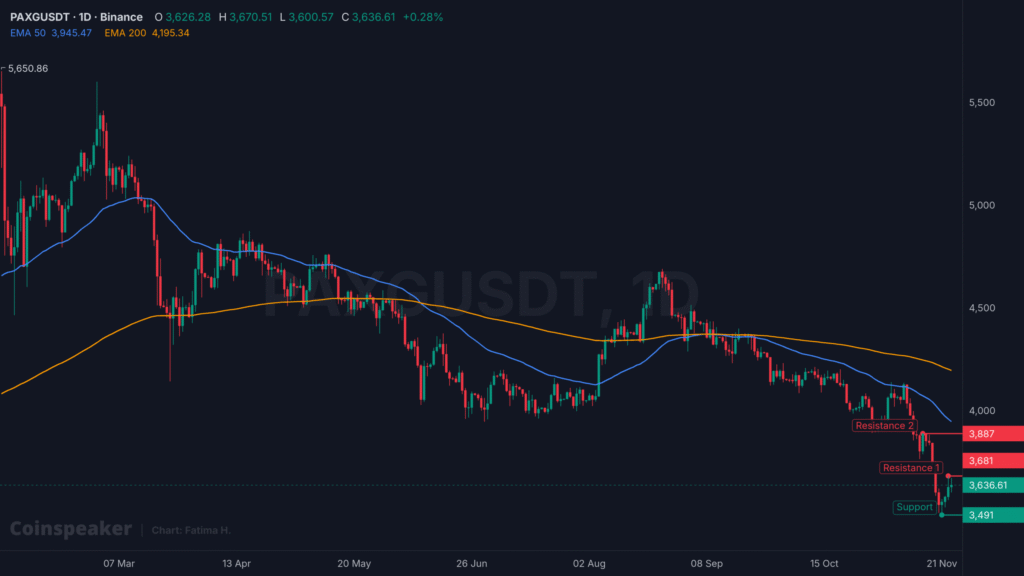
PAXG traded at $3,637 on Binance, below its 50-day and 200-day exponential moving averages of $3,945 and $4,195. It had reached a 300-day low of $3,491 on November 21. Over the seven days covered by the report, sell orders executed immediately on Binance’s spot market outweighed equivalent buy orders by a net $13.4 million.
Coinspeaker’s price analysis used the November 21 low and the November 23 high of $3,681 to frame three scenarios, not confirmed moves. It described trading between those levels as a possible holding pattern, identified the November 15–17 ceiling of $3,887 as a level to watch after a daily close above $3,681, and cited $3,400 as the next round level after a daily close below $3,491.