In an X post discussed by Odaily on November 9, 2026, Vitalik Buterin argued that Ethereum should place greater emphasis on ETH as a store of value than on maximizing transaction-fee burns. He said EIP-1559 and its burn mechanism should remain, but that even if burns stayed below 10% of new issuance over the long term, that would not mean ETH lacked other sources of value.
Why a burn-based valuation may be fragile
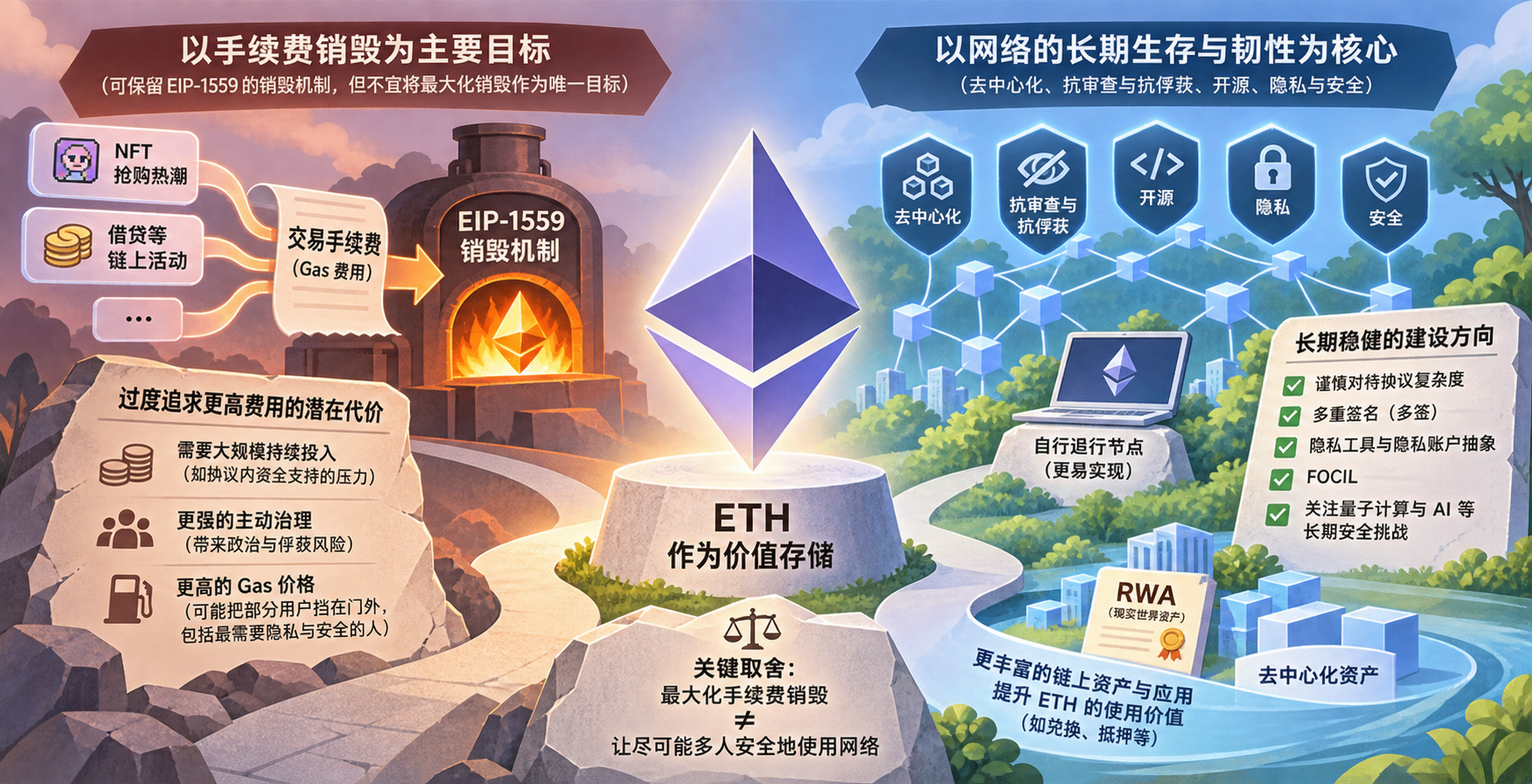
Buterin described a simplified valuation model: $1 billion in annual burns, sustained indefinitely at a 4% discount rate, would imply a $25 billion valuation. The difficulty, he argued, is that much of Ethereum’s fee revenue during the heavy-burn period of 2021–2023 came from activity within crypto. If ETH’s price fell sharply, participants in those activities might also have less to spend on fees. He cited NFT buying frenzies—including an episode with roughly $180 million in fees burned in a day—and lending as examples.
Demand from outside crypto would make a fee-based valuation more persuasive, in his view. Growing real-world asset (RWA) activity could provide some of that demand, but he cautioned that stable businesses are unlikely to reproduce the exceptional fees generated by speculative surges.
The trade-off in pursuing higher fees
Buterin argued that supporting ETH’s roughly $270 billion market capitalization primarily through burns would push Ethereum toward the spending and active governance of a large company. In a hypothetical comparison with L’Oréal, he used what he described as an AI-generated estimate of its annual research spending—about 0.58% of market value—to suggest Ethereum might need roughly 700,000 ETH a year in protocol funding, while validator income fell by about two-thirds. These were estimates for a scenario, not proposed or enacted funding changes.
He also warned that seeking more fee revenue could mean higher gas prices, excluding some people who most need privacy and security. Maximizing fees and enabling as many people as possible to use the network safely are different goals.
Survival as the measure
For ETH held as a store of value, Buterin proposed a different test: whether Ethereum can endure while preserving decentralization, resistance to censorship and capture, open source development, privacy and security. He called for caution about protocol complexity and new rewards that interest groups might influence, alongside work on multisignature security, privacy tools, privacy-focused account abstraction and FOCIL. He also pointed to the importance of running a node without heavy reliance on infrastructure providers, saying his laptop could sync one in under six hours while using about one-eighth of its disk space.
Buterin did not frame applications and store-of-value use as opposites. More RWA and decentralized assets issued on Ethereum’s base layer, he argued, could make ETH more useful for exchange or as collateral. His distinction was between growth that benefits from Ethereum’s security and a strategy that treats the largest possible fee burn as the network’s overriding goal.