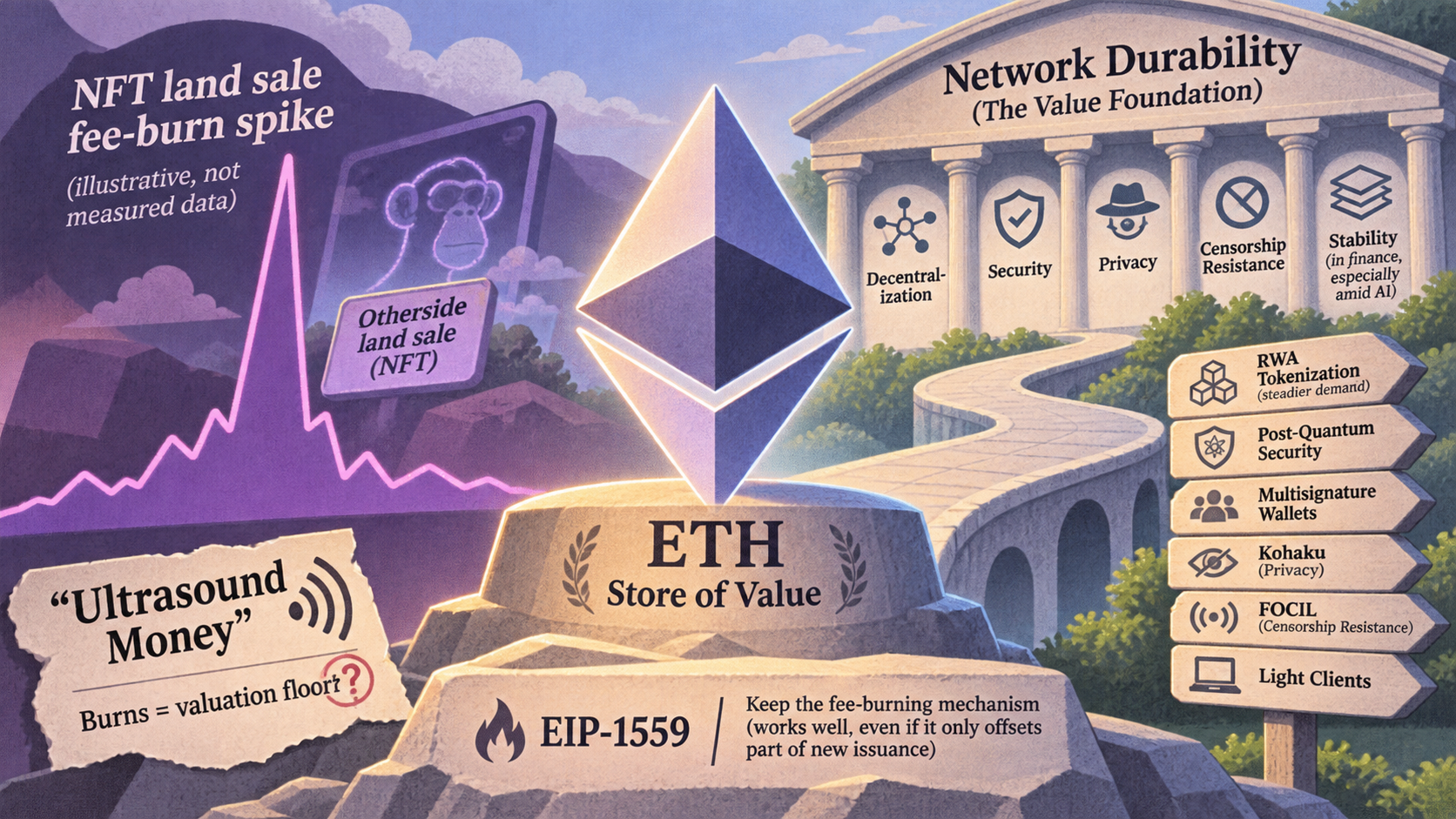
An NFT land sale once sent Ethereum’s fee burn soaring. In remarks reported on November 9, 2026, Vitalik Buterin used episodes like that to question whether burned fees provide a reliable foundation for valuing ETH. He argued that ETH makes more sense as a store of value than as a token whose worth depends on transaction fees being destroyed.
Buterin was not calling for the fee-burning mechanism to end. He said EIP-1559, introduced in 2021, works well and should remain even if the ETH it burns offsets only part of new issuance. In his view, ETH’s value rests more on Ethereum’s decentralization and its continued work on censorship resistance, privacy and security. He also described stability as a practical contribution to finance, particularly amid disruption from AI.
Why an NFT fee spike is a shaky benchmark
The fee-burn argument helped fuel the “ultrasound money” narrative among ETH holders during the 2021 bull market. Buterin described a model in which a token’s market value equals its annual burn divided by a discount rate: a $1 billion annual burn at 4% would imply a theoretical $25 billion valuation floor. He cautioned that the floor is not dependable when the activity generating fees is itself tied to the crypto market and may shrink alongside ETH’s price.
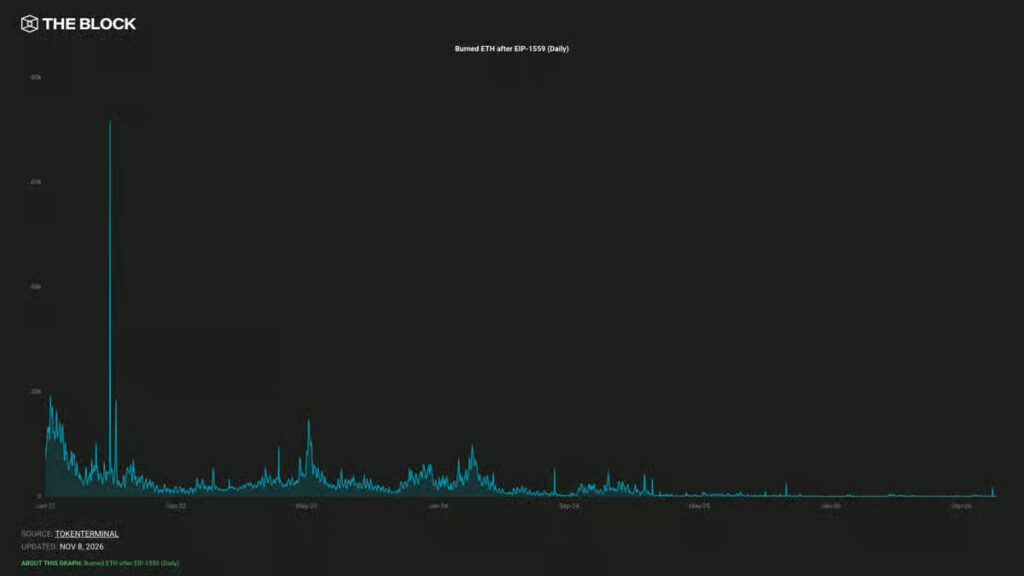
He pointed to an NFT sale that generated $180 million in burned fees in a single day. The report identified it as Yuga Labs’ Otherside land sale, during which some buyers paid more than $10,000 in fees to acquire Otherdeed NFTs. According to the report, an Otherdeed’s market price was about $150 at the time of publication. The contrast illustrates how an intense burst of participation need not translate into lasting fee demand.
The Block’s figures cited in the report put Ethereum’s burn at roughly 1.48 million ETH, worth about $3.6 billion, in 2022. By November 9, 2026, the reported year-to-date total was about 19,200 ETH, worth $43 million. Buterin said growing real-world asset tokenization offers a better basis for demand from outside crypto, though he did not expect that steadier activity to recreate past fee spikes.
What Buterin wants the network to preserve
Buterin argued that optimizing for burns could encourage higher gas fees, excluding some users who most need privacy and security. He also said making burns a long-term priority would require more interventionist governance, at odds with his goal of a decentralized network resistant to capture. For people treating ETH as a store of value, he said, the foremost test is whether the network can endure.
He linked that goal to work on post-quantum security, multisignature wallets, the Kohaku privacy project, the FOCIL censorship-resistance proposal and light clients. These are areas of work he cited, not evidence that every proposed change has been adopted.
The debate also reached a separate proposal, EIP-8363, which would have increased the share of validator rewards burned as ETH staking grew. Its co-authors had withdrawn it from consideration for the forthcoming Hegota upgrade five weeks before Buterin’s post. That proposal was not an enacted rule. Solana co-founder Anatoly Yakovenko agreed with Buterin’s argument that fees should not be treated as the core product; others quoted in the report offered their own favorable interpretations of the store-of-value narrative. Their endorsements do not settle how ETH should be valued.